In Venice a bridge is rarely a landmark you travel to. It is the thing you climb every few minutes on the way to somewhere else: a dozen steps up, a glance along the rio, a dozen steps down.
How many bridges?
Ask how many bridges Venice has and you will hear 391, 435 or 472, depending on who is counting. The differences come mostly from what is included: private bridges that lead to a single door, the bridges of the Giudecca, Murano and Burano, and the long causeway to the mainland. The honest answer is more than 400, nearly all of them small.
Most cross a single rio with one arch, high enough in the middle for a boat to pass underneath and climbed by a short flight of steps on each side. Their names usually come from the nearest church or campo, from a family that paid for them, or from a local trade, so the sign beside a bridge often tells you something about the neighbourhood.
From planks to stone arches
Early Venice moved mostly by boat. The first crossings were wooden and low, closer to walkways than to the bridges you see today, and in the Middle Ages horses were still a common sight in the city. Some larger timber bridges, including the early ones at Rialto and at the Tre Archi, had lifting sections in the middle so that masted boats could pass.
Over the following centuries the wooden bridges were rebuilt in brick and stone, as arches tall enough for gondolas and cargo boats to slip beneath. Steps became the rule, and riding through the city went out of use. Railings came surprisingly late: many bridges had none until the 18th or 19th century, as old paintings of the city show, and they were added, so the usual account goes, after too many people had fallen into the water.
Two bridges still show the older form. The Ponte Chiodo, over the Rio di San Felice in Cannaregio, is a small stone arch named after the Chiodo family who once owned it, with nothing at its edges but air. The other usually cited is the Ponte del Diavolo on Torcello.
The four Grand Canal bridges
Until 1854 there was only one way to cross the Grand Canal on foot. Today there are four bridges, all of them busy, and each belongs to a different age.
| Bridge | Opened | Designer | Built of | Note |
|---|---|---|---|---|
| Rialto | 1591 | Antonio da Ponte | Istrian stone | The only crossing until 1854; two rows of shops |
| Accademia | 1933 | Eugenio Miozzi | Timber over a steel frame | Meant to be temporary; rebuilt in the same form in 1984–86 |
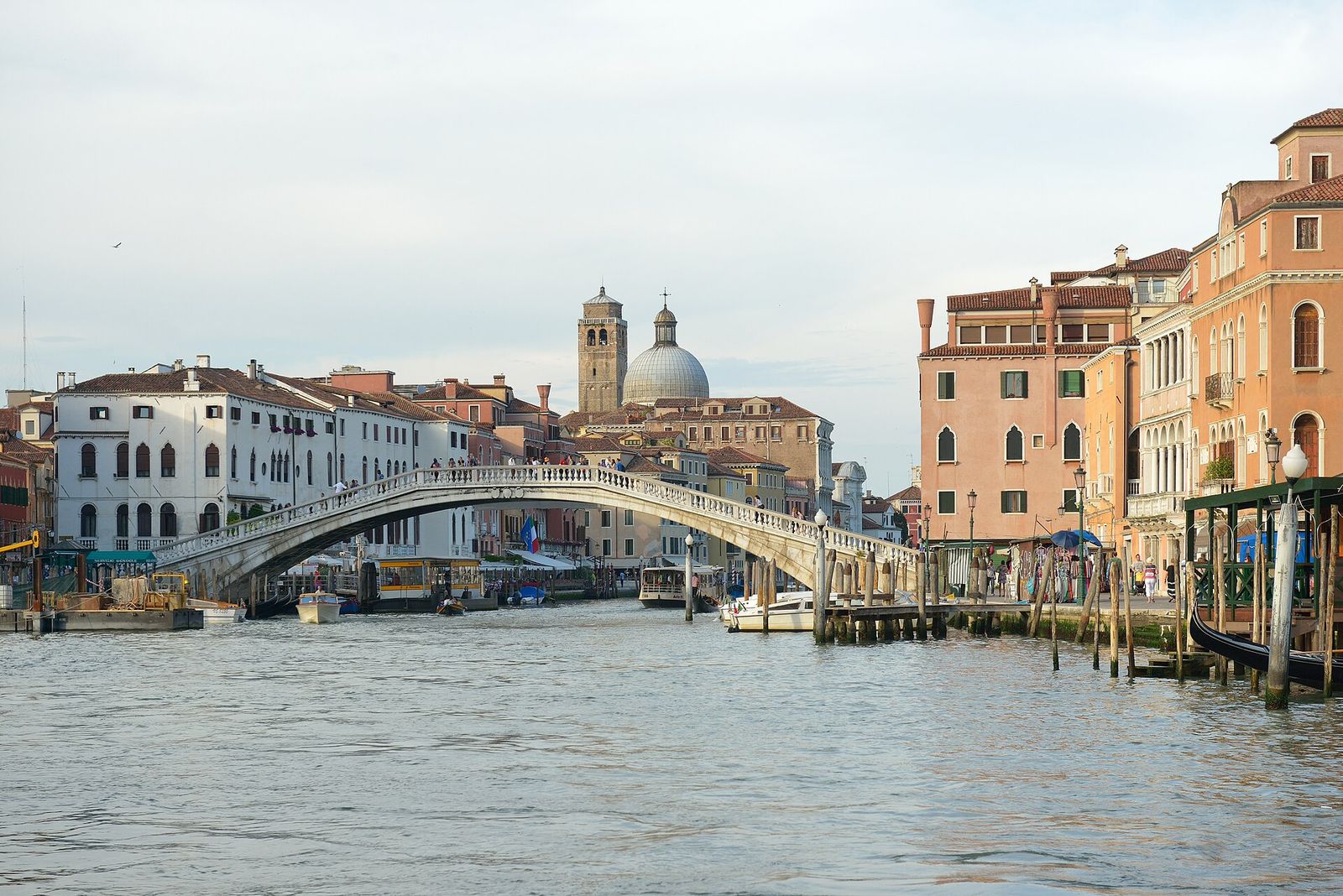
| Scalzi | 1934 | Eugenio Miozzi | Istrian stone | Replaced an Austrian iron bridge of 1858 |
| Costituzione | 2008 | Santiago Calatrava | Steel, stone and glass | Links Piazzale Roma with the railway station |
The Rialto replaced a series of wooden bridges, the first a pontoon of the late 12th century; one collapsed under a crowd in 1444, another in 1524. When the Republic finally chose stone, it passed over designs by Sansovino and Palladio, among others, and built Antonio da Ponte’s single arch between 1588 and 1591. It spans close to 30 m and carries shops in two rows on either side of a central portico, with outer walkways along the edges.
The three modern bridges owe a great deal to one man. Eugenio Miozzi, head of the city’s technical office from 1931, designed the wooden Accademia bridge of 1933 to replace a metal one of 1854, and the stone Ponte degli Scalzi of 1934 in front of the station. The Accademia was supposed to be temporary; instead it was rebuilt in the mid-1980s with the same profile and a steel structure beneath the timber. Its steep wooden steps can be slippery in rain.
The Ponte della Costituzione by Santiago Calatrava opened in 2008. Its long, low steel arch spans about 80 m between Piazzale Roma and the station. It was criticised from the start because wheelchair users could not cross it: a cabin lift added later proved troublesome and has been dismantled. Its glass treads also caused falls, and in 2022 the city decided to replace them with stone.
Bridges with stories
The Bridge of Sighs
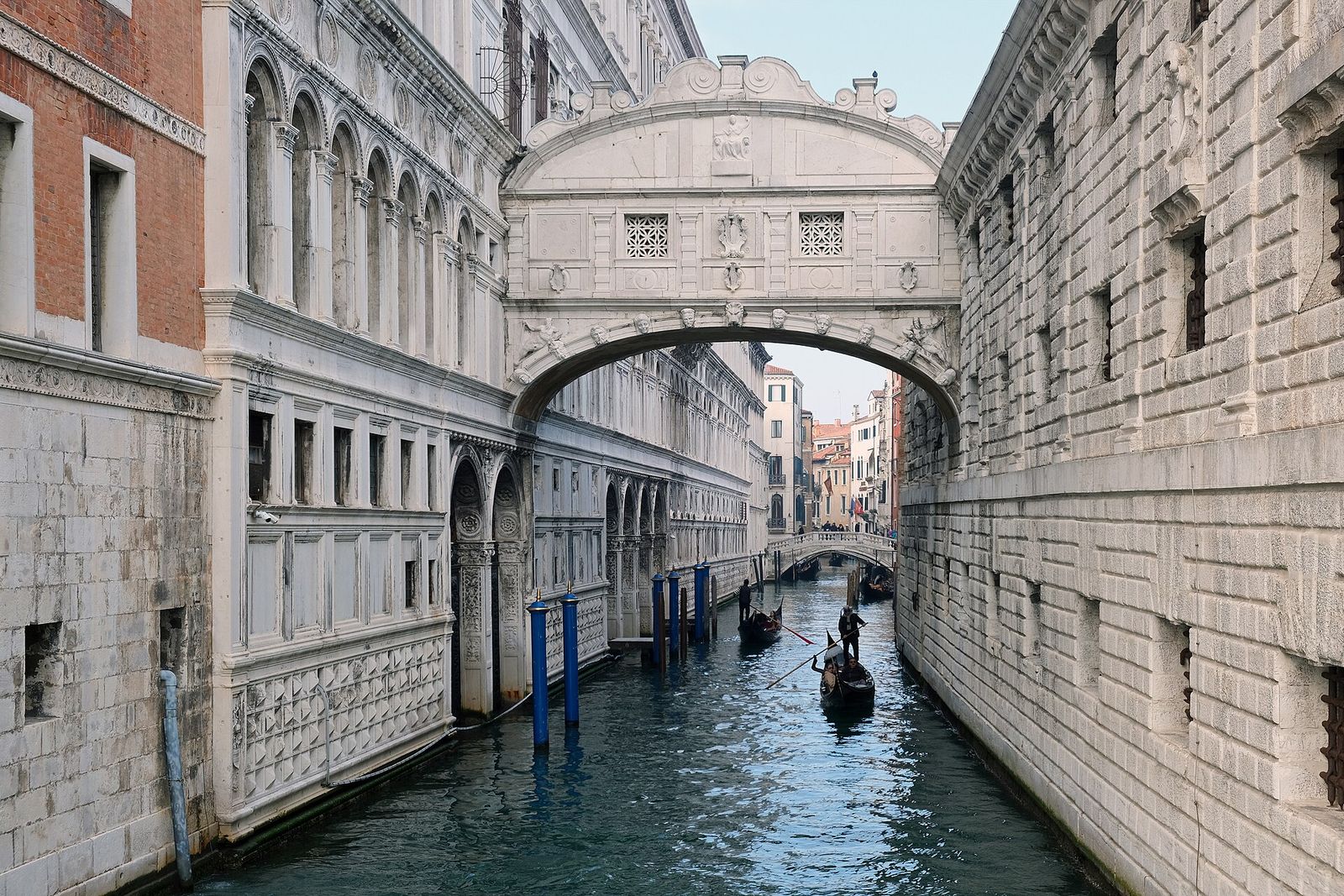
Soon after 1600 Antonio Contin, nephew of the Rialto’s architect, built an enclosed bridge of white Istrian limestone over the Rio di Palazzo. It links the interrogation rooms and courts in the Doge’s Palace with the New Prisons on the other side, and its small windows are screened by stone bars. The famous name is much later. It is a Romantic creation of the 19th century, popularised by Lord Byron, who opened the fourth canto of Childe Harold’s Pilgrimage (1818) on this bridge. The story of prisoners sighing at a last glimpse of the lagoon belongs to the same Romantic tradition.
The best view from outside is from the Ponte della Paglia on the waterfront. The interior can be crossed as part of a visit to the Doge’s Palace; check the museum’s official information for current routes.
Ponte dei Pugni
Near Campo San Barnaba in Dorsoduro, the bridge of fists recalls the organised brawls between the city’s two great rival factions, the Castellani from the east of the city and the Nicolotti from the west. Their rivalry dates back to the 14th century. Teams met on the bridge and tried to force each other into the canal; four marble footprints set into the top still mark the starting positions. The tradition ended in the early 18th century, after a fight in 1705 turned into a bloodbath.
Ponte delle Guglie and Ponte dei Tre Archi
The two bridges over the Cannaregio Canal make a good pair. The Ponte delle Guglie, on the main walk from the station towards the Rialto, replaced a wooden bridge in 1580 and gained its pinnacles in 1823; a restoration in 1988 added an easier route for people with reduced mobility. Further north, near the lagoon, the Ponte dei Tre Archi was rebuilt in stone in 1503 and again in 1688 by Andrea Tirali. It is the only three-arched bridge left in Venice. The canals chapter suggests a walk that links the two.
Bridges to the mainland
For most of its history Venice could be reached only by water. That ended in 1846, when a railway bridge across the lagoon opened under Austrian rule. In 1933 a road bridge was built alongside it, designed by Miozzi and opened as the Ponte Littorio; it was renamed Ponte della Libertà after the Second World War. At about 3.85 km it is by far the longest bridge in the city, and it ends at Piazzale Roma, the only place in the historic centre that cars can reach. Both show clearly on satellite images of the lagoon.
Bridges for a few days
Twice a year Venice builds a bridge that it takes away again. For the Festa del Redentore, on the third Sunday in July, a pontoon bridge crosses the Giudecca Canal from the Zattere to Palladio’s church of the Redentore, built in thanks for the end of the plague of 1575–77. For the Festa della Salute on 21 November, a second pontoon bridge crosses the Grand Canal from Campo Santa Maria del Giglio to Santa Maria della Salute, the church vowed after the plague of 1630.
Both stay up for a few days around the feast, the only times of year when you can walk across these two stretches of water.
Steps, luggage and routes without steps
A route that looks short on the map can cross ten or more bridges, each with steps up and down, and there is usually no way round. A little planning helps, especially with luggage or a pushchair.
- Count bridges, not distanceBefore you set off with bags, trace the route on a map and count the bridges. Sometimes a water bus to a nearer stop saves a dozen flights of steps.
- Carry, do not bumpLift wheeled cases over the steps rather than dragging them down one by one. It is easier on the bag, on the stone and on everyone behind you.
- Watch the edges in the wetIstrian stone becomes slippery after rain and at high tide. The pale stone edging on many steps marks where each tread ends.
- Use the water buses to avoid stepsWater buses are the main way to move around without climbing bridges (see Getting Around by Water). The City of Venice publishes accessibility maps showing which areas can be reached from each stop without crossing a bridge.
Questions
Can you go inside the Bridge of Sighs?
Yes, as part of a visit to the Doge’s Palace, whose itinerary passes through the bridge into the prisons. Routes and access arrangements change, so check the museum’s official information.
Is there a way from the station to St Mark’s without bridges?
Not on foot: every walking route crosses several. The water bus along the Grand Canal is the alternative without steps.
Why do some bridges have no railings?
Because that is how most Venetian bridges were originally built. Railings were added to nearly all of them later; the Ponte Chiodo and Torcello’s Ponte del Diavolo are the best-known survivors without them.