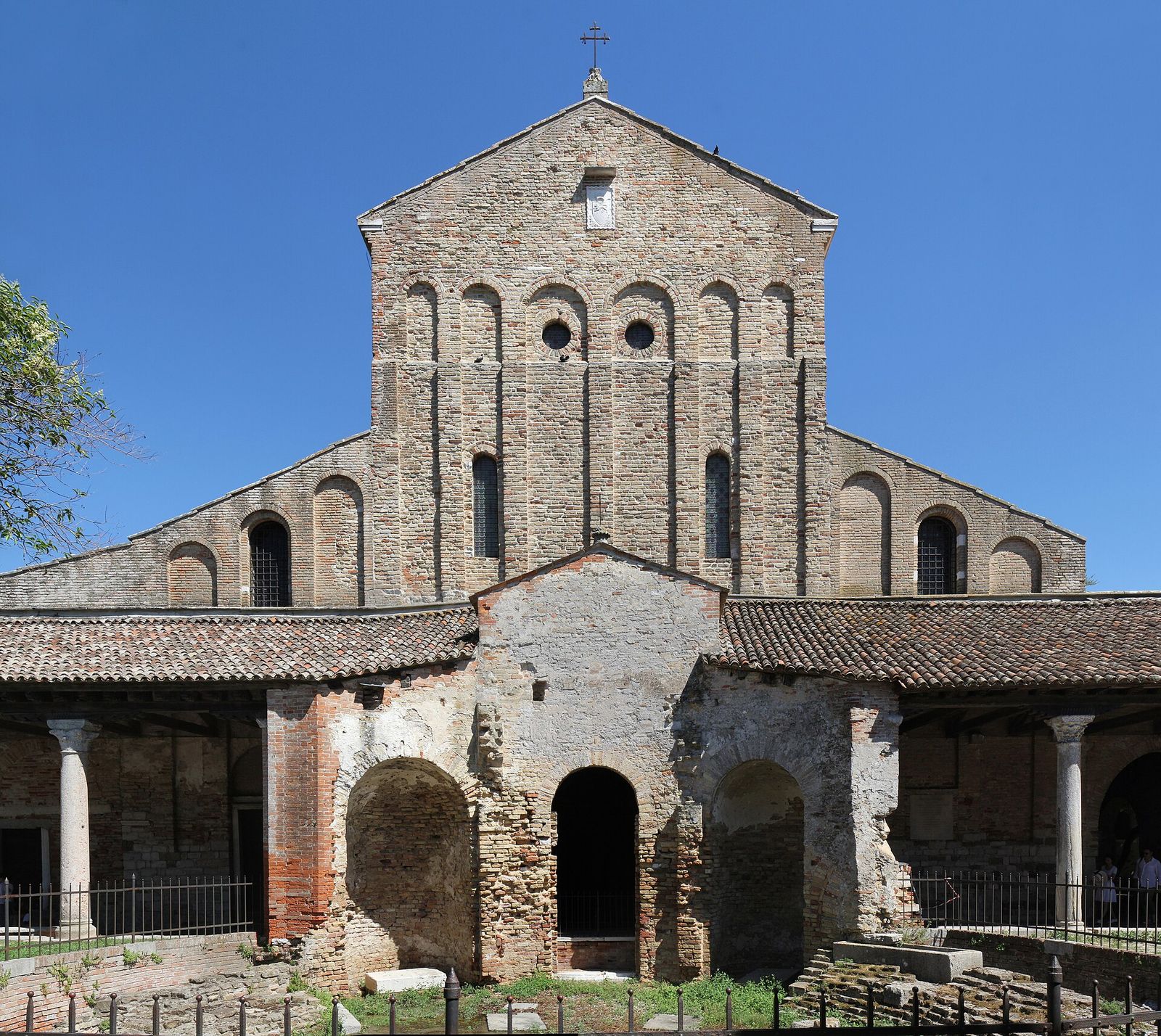
Torcello lies in the northern lagoon, a few minutes by boat beyond Burano. A thousand years ago it was one of the most important places in the lagoon. Today only a handful of people live here, and the main reason to come is a cathedral older than almost anything in Venice itself.
A town that faded into the marsh
The first settlers came from the mainland, above all from the Roman town of Altinum, today’s Altino, on the lagoon’s northern shore. As invaders crossed the Veneto between the fifth and seventh centuries, its people moved out into the marshes, where shallow water that only local boatmen could read protected them. In the seventh century the bishop of Altino followed, and Torcello became the religious centre of the northern lagoon.
The island prospered on trade, salt and wool. How many people lived here at its height is disputed: older accounts speak of tens of thousands, while recent archaeological estimates suggest a few thousand at most.
The decline came slowly, and it came from the water. Rivers carried silt into this corner of the lagoon, channels grew too shallow for trading boats, and the stagnant marsh bred malaria. By the end of the Middle Ages many families had moved to Murano, Burano or the growing city around Rialto. The bishop’s seat moved to Murano in 1689, and builders carted away stone and brick from abandoned houses for use in Venice. What remains is the old core: the cathedral, Santa Fosca and a few civic buildings around a grassy square. To see why some parts of the lagoon silted up while others stayed open, read our chapter on the lagoon and its rivers.
The cathedral of Santa Maria Assunta
An inscription found in the church, whose reading scholars still debate, dates its foundation to 639, when this part of Italy still answered to Byzantium. That makes Santa Maria Assunta the oldest cathedral in the lagoon. Most of the building you see today comes from later rebuildings, the last of them in the early eleventh century: a tall brick basilica with a nave and two aisles, a low portico across the front and, beyond it, the foundations of an early baptistery. On the south side, the windows close with shutters made from single slabs of stone.
The Last Judgement
The whole west wall, which you see as you turn to leave, is covered by a mosaic of the Last Judgement made by Byzantine-trained craftsmen in the eleventh and twelfth centuries. It reads in horizontal bands from top to bottom: the Crucifixion, Christ’s descent into Limbo, Christ in judgement among the apostles, and then the weighing of souls and the separation of the saved from the damned. Hell, on the right as you face the wall, includes skulls crawling with worms. Above the door, at the foot of the composition, the Virgin stands with her hands raised in prayer.
The apse and the marble screen
At the opposite end of the church the apse holds a single tall figure of the Virgin and Child against a plain gold ground, with the apostles in a row beneath her. The empty gold around her is deliberate, and unforgettable. In front of the sanctuary a marble screen with carved peacocks and lions closes off the choir, with painted panels of the Virgin and the apostles above it, and the floor is a patchwork of coloured marble.
Santa Fosca and the square
Beside the cathedral stands the smaller church of Santa Fosca, built around the eleventh and twelfth centuries on a Greek-cross plan. An arcaded portico of brick and marble columns runs round five sides of it, throwing sharp shadows in the afternoon sun. Inside, the space is bare, almost geometric, and very quiet.
Attila’s Throne
On the grass of the square stands a rough stone armchair known as Attila’s Throne. It has nothing to do with the king of the Huns, who never came here. The likeliest explanation is that it served the local magistrates or the bishop, perhaps when justice was administered in the open.
The Torcello Museum
Two fourteenth-century buildings on the square, the Palazzo del Consiglio and the Palazzo dell’Archivio, house the Torcello Museum. Its archaeological finds from Altino and the lagoon and medieval fragments from the island’s churches help you picture the town that has vanished around them.
Climbing the bell tower
The square brick campanile behind the cathedral dates from the eleventh century and can be climbed when it is open to visitors. From the top you see the whole northern lagoon, Burano’s leaning tower close by and, on clear winter days, the Alps.
The Devil’s Bridge and the marshes
From the water-bus stop a paved path follows a straight canal inland to the square, a walk of ten to fifteen minutes past a few houses and gardens. On the way you pass the Ponte del Diavolo, the Devil’s Bridge: a single brick arch over the canal with no parapets at all. Bridges without side walls were once normal across the lagoon, and very few are left; another is the Ponte Chiodo in Cannaregio, described in our chapter on the bridges of Venice. Local legends tie the name to a pact with the devil, though no two tellings agree.
Around the inhabited core, much of the island and its neighbours is barena: salt marsh that floods only at the highest tides, covered in low, tough plants that turn rust-coloured in autumn. Shallow channels and mudflats, called velme, surround it. This is good country for birds. Little egrets and grey herons stalk the shallows, cormorants dry their wings on the wooden channel markers, and in the colder months wading birds feed on the exposed mud at low tide.
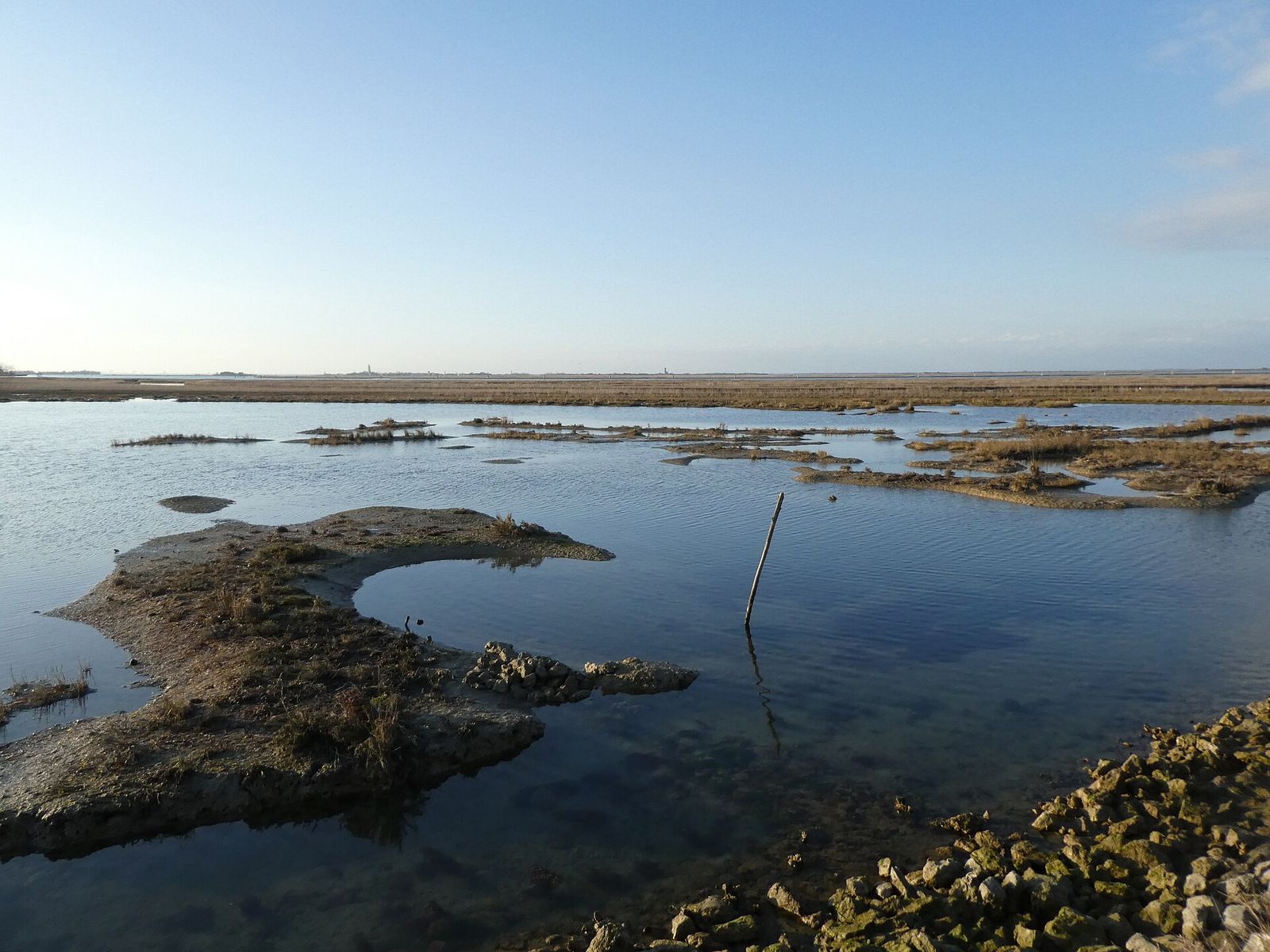
Most of this landscape is private land or protected marsh without paths, so enjoy it from the canal path, the bell tower or the boat, ideally early or late in the day.
How to get there
Torcello has a single water-bus stop at the end of the canal path. Boats from the city usually call at Burano first, and a short shuttle links the two islands. Journey times are typical.
Route card
Fondamente NovetoTorcello
Tip
Read the platform sign: some boats continue to Torcello, others end at Burano.
Route card
BuranotoTorcello
Tip
Boats run less often than on the main lines, so note the return times when you land.
Route card
Torcello stoptoCathedral
Tip
The path is flat but has little shade; carry water in summer.
Timetables change with the seasons. Check the public transport operator’s official information before you travel, and see Getting Around by Water for how stops and lines work.
Visiting sensibly
- Combine it with BuranoCome to Torcello first, in the morning, when it is at its quietest, and spend the afternoon among the painted houses of Burano and Mazzorbo.
- Dress for a churchThe cathedral and Santa Fosca are places of worship, and covered shoulders and knees are expected.
- Bring what you needThere are only a few places to eat. Bring water, sun protection and, in summer, insect repellent.
Questions visitors ask
Can I walk from Burano to Torcello?
No. A channel separates the two islands. Burano is linked by a footbridge to Mazzorbo, not to Torcello, so the crossing is made by boat.
How long should I allow?
Half a day from the city, including the boats and the walk; a full day if you add Burano.
Does anyone still live on Torcello?
Yes, but very few people: recent counts put the permanent population at around ten.