Venetian words
Venetian Water Words
The vocabulary of canals, tides, streets and boats that you will meet on signs, maps and water-bus announcements, explained in plain English.
Venice names its places with a vocabulary of its own. A street is rarely a via and a canal is usually a rio, while the only square traditionally called a piazza is St Mark’s. Most of these words come from Venetian, the language of the old Republic and still spoken in the city; a few are standard Italian used in a local sense. Learn a dozen of them and the signs on the walls begin to tell you how the city once looked, before many of its canals were filled in and its marshes drained.
Terms run from A to Z, with plurals, which signs often use, and stress marks for the trickier words. Links lead to the chapters where a subject is explained in full, such as Canals & Rii.
A
- acqua altanoun
An exceptionally high tide that floods the lowest parts of the city, mostly from autumn to early spring. It builds when a high tide meets a south-easterly wind and low air pressure; sirens give warning.
See also Tides, Acqua Alta & MOSE.
- altananoun · plural altane
A wooden platform raised on posts above a roof, recorded since at least the fourteenth century. Venetians use altane for drying laundry, catching the breeze and watching regattas.
B
- barenanoun · plural barene
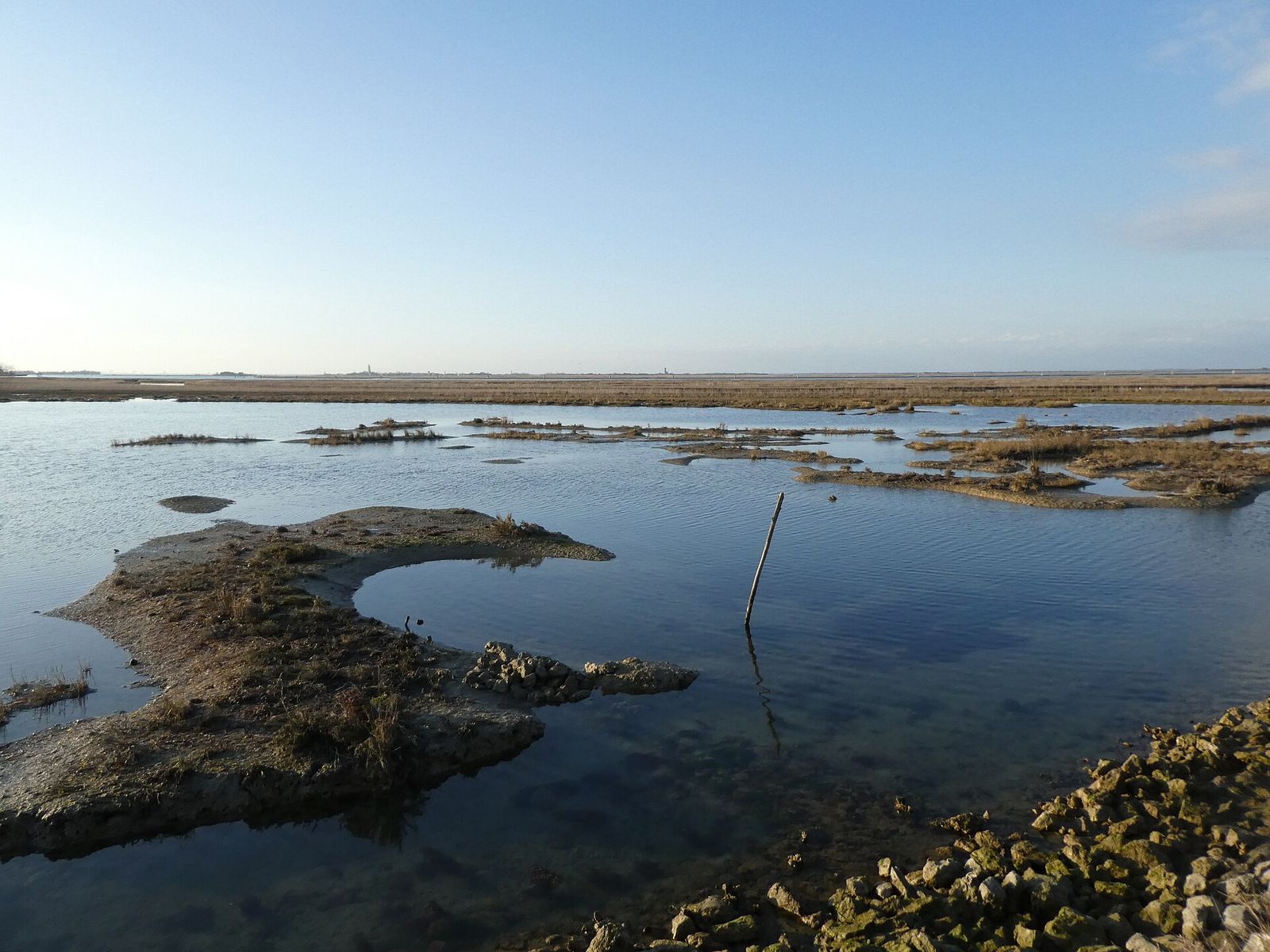
A salt marsh: a low island of silt and clay held together by salt-tolerant plants and flooded only by the highest tides. Barene slow the currents, and their erosion is a serious problem for the lagoon.
See also velma and The Lagoon & Its Rivers.
- bocca di portonoun · plural bocche di porto
One of the three inlets between the lagoon and the Adriatic: Lido, Malamocco and Chioggia. Every tide passes through them, and they house the MOSE flood gates, in use since 2020.
- bricolanoun · plural bricole
A cluster of two or more stout wooden piles bound together at the top, marking the edge of a navigable channel. Outside a line of bricole the water can be very shallow.
See also palina.
C
- callenoun · plural calli
The ordinary Venetian word for a street, from the Latin callis, ‘path’. A calle larga is a wide one; the narrowest are barely a shoulder-width across.
- campiellokam-PYEL-lonoun · plural campielli
A small campo, often no more than a widening of the street with a wellhead in the middle.
- camponoun · plural campi
A city square. The name means ‘field’: many were once unpaved and grassy. Each parish grew around its campo, with a church and one or more wellheads. The only square traditionally called a piazza is St Mark’s.
- canalenoun · plural canali
A large canal. Only a few waterways carry the name, among them the Canal Grande, the Canale della Giudecca and the Canale di Cannaregio; almost every other canal in the city is a rio.
See also The Grand Canal.
- cavananoun · plural cavane
A covered boat shelter. The first were thatched huts on the shore; later cavane were built into the ground floor of houses, opening onto a rio through an arch at water level.
- cortenoun · plural corti
A courtyard surrounded by houses, often reached through a sotoportego and often a dead end. Many corti were shared by several families and have a wellhead of their own.
F
- felzenoun
The small removable cabin once fitted to gondolas to shelter passengers from the weather and from curious eyes. It fell out of use in the early twentieth century.
- ferronoun
The metal ornament on a gondola’s bow, which also balances the gondolier’s weight at the stern. Reading its six prongs as the six sestieri is a later legend: older ferri had fewer.
- fondamentanoun · plural fondamente
A paved quay along a canal. Where a rio has none, the houses rise straight out of the water. The Fondamente Nove, the ‘new quays’ on the northern edge of the city, take their name from it.
See also riva.
- forcolaFOR-ko-lanoun · plural forcole
The carved oarlock of a gondola, usually of walnut, shaped so that a single oar can drive the boat forward, turn it, slow it, reverse and stop. Each is made to measure.
G
- ghebonoun · plural ghebi
A narrow, winding natural channel through the barene, carved by the tide. Ghebi hold water at almost every state of the tide, so small boats can follow them deep into the marsh.
I
- imbarcaderonoun · plural imbarcaderi
A landing stage, and in everyday speech a water-bus stop as a whole. The larger ones have several pontoons, each serving different lines.
See also pontile.
L
- lidonoun · plural lidi
A long, narrow sandbar between the lagoon and the open sea. The Lido of Venice is the best known, and its bathing beaches gave English the word ‘lido’ for an open-air pool or beach.
See also Lido & Pellestrina.
M
- motoscafonoun · plural motoscafi
A motor launch. In Venice the word also covers the lower, quicker boats of the public fleet used on the lines round the city, as well as private launches and water taxis.
- murazzinoun, plural
The massive sea walls of Istrian stone built between 1744 and 1782 to protect the Lido, Pellestrina and Sottomarina from Adriatic storms. Long stretches still stand on the seaward side.
See also Lido & Pellestrina.
N
- nizioletonee-tsyo-LEH-tonoun · plural nizioleti
A street-name sign painted on a wall in black letters on a white rectangle; the name means ‘little sheet’. It gives the type of place and its name, which often recalls a trade, a family or a lost canal.
P
- palinanoun · plural paline
A single wooden pole driven into the bed of a canal for mooring a boat. In front of palaces, paline are often painted in spiral stripes in the colours of the family.
See also bricola.
- piscinanoun · plural piscine
In Venetian place names, not a swimming pool but a former pond or stretch of water that has been filled in and paved. Piscina San Samuele, near the Grand Canal, is one example.
See also rio terà.
- pontilenoun · plural pontili
The floating pontoon of a water-bus stop, linked to the quay by a hinged ramp so that it rises and falls with the tide.
See also Getting Around by Water.
R
- ramonoun · plural rami
Literally ‘branch’: a short side alley off a calle, often a dead end that stops at a canal with no bridge.
- rionoun · plural rii
A canal, and the ordinary word for almost every waterway in the city except the few large canali. Counts range from about 150 to 177, depending on what is included.
See also Canals & Rii.
- rio terànoun · plural rii terà
A canal that has been filled in and turned into a street; terà means ‘filled with earth’. Most were filled in the nineteenth century, but the practice is much older.
See also piscina.
- rivanoun · plural rive
A quay on a wide stretch of water where boats can land, such as the Riva degli Schiavoni on the basin of St Mark’s. A riva is broader and more open than a fondamenta.
- ruganoun · plural rughe
An old name for a long street lined with shops, possibly from the French rue. Several survive around Rialto, the old market district.
S
- saccanoun · plural sacche
A bay or enclosed stretch of water at the edge of the city, such as the Sacca della Misericordia. Some sacche were filled to make new land that kept the name, as at Sacca Fisola.
- salizadanoun · plural salizade
One of the first streets to be paved, in brick from the late fourteenth century, when most calli were still beaten earth. A salizada is usually an important through route.
- sandolonoun · plural sandoli
A light, flat-bottomed rowing boat, smaller and simpler than a gondola and rowed standing up. It is used for fishing, getting about and learning to row the Venetian way.
- sestierenoun · plural sestieri
One of the six districts of the historic city: Cannaregio, Castello, Dorsoduro, San Marco, San Polo and Santa Croce. The Giudecca belongs to Dorsoduro. House numbers run through each sestiere rather than street by street.
See also Getting Around by Water.
- sotoportegoso-to-POR-te-gonoun · plural sotoporteghi
A covered passage that runs under a building, often low and dark with wooden beams overhead, linking two streets or leading to a courtyard or a canal. Also spelt sottoportego.
- squeroSKWEH-ronoun · plural squeri
A boatyard where gondolas and other traditional boats are built and repaired, with a slipway into the water. The Squero di San Trovaso in Dorsoduro, still at work, can be seen from across its rio.
- stazionoun · plural stazi
A gondola station: the landing where gondoliers wait for passengers. By extension, any official boat rank, such as a water-taxi stand.
T
- toponoun · plural topi
A traditional cargo boat of the lagoon, once sailed and now usually motorised. The motor topo is the city’s delivery van, carrying everything from groceries to building materials.
- traghettonoun · plural traghetti
A ferry. In the city it means the gondola ferry rowed by two gondoliers across the Grand Canal at a few fixed points.
See also Getting Around by Water.
V
- valle da pescanoun · plural valli da pesca
A stretch of lagoon enclosed by embankments for extensive fish farming. Young fish come in from the sea and are kept inside to grow; roughly a sixth of the lagoon’s water surface is used this way.
- vaporettonoun · plural vaporetti
The public water bus, named after the small steamers that appeared in 1881. Strictly it means the large, slow boats with an open deck; in everyday use, any public water bus.
See also Getting Around by Water.
- velmanoun · plural velme
A mudflat that lies bare at low tide and under water at high tide, lower than a barena and without its plant cover. Wading birds feed on the velme at low water.
See also barena.
- vera da pozzonoun · plural vere da pozzo
A carved stone wellhead over a cistern. Rainwater from the paving filtered through sand into a central shaft; until the aqueduct from the mainland opened in 1884, this was the city’s drinking water. Hundreds survive, sealed with metal lids.