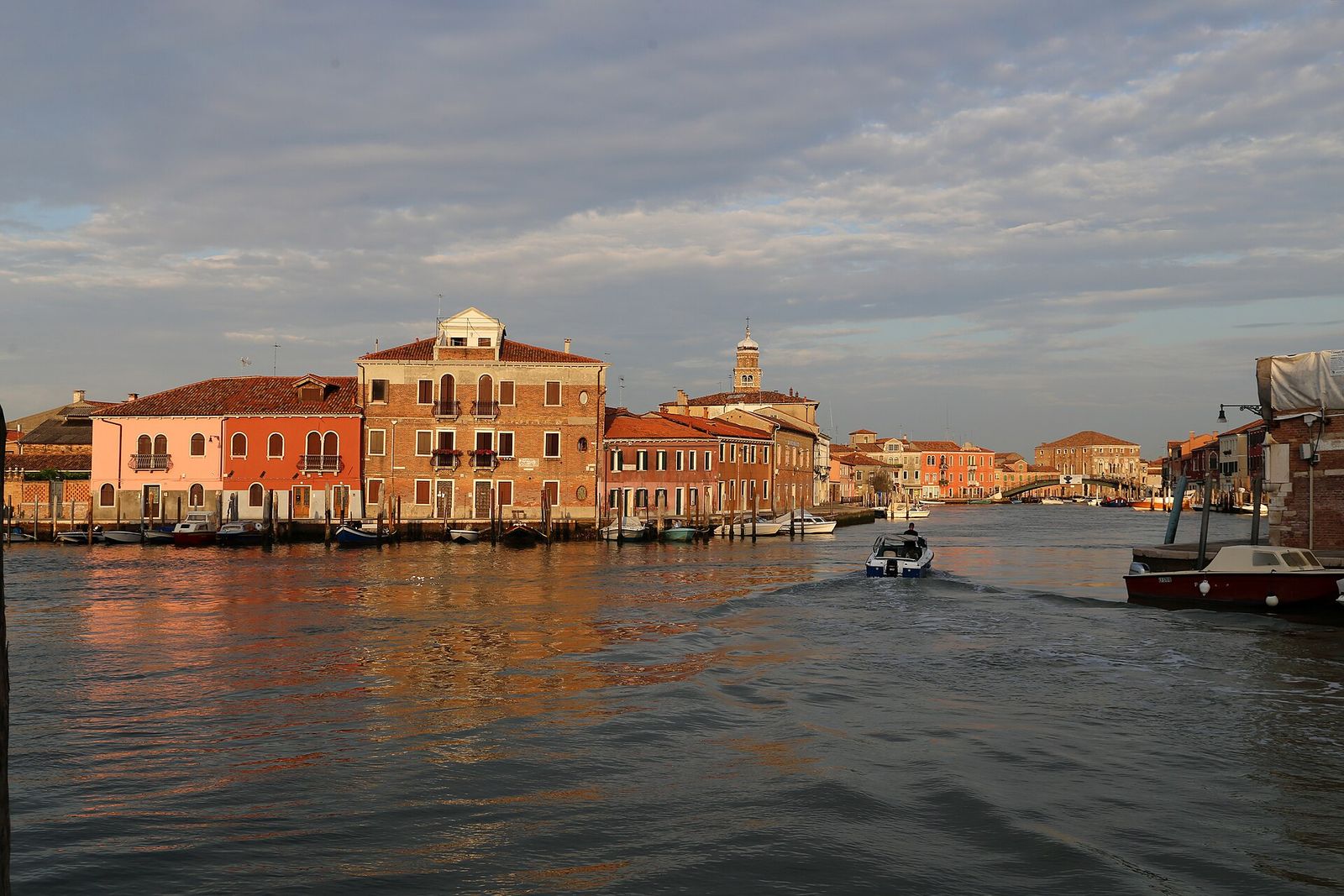
Murano lies about 1.5 km north of the historic city, across open water from Fondamente Nove. It is made of seven islands linked by bridges over eight channels, and for more than seven hundred years its name has meant glass.
An island of furnaces
In 1291 the Republic ordered the glassmakers of Venice to move their furnaces to Murano. The reason given was fire: the city was still built largely of wood, and a glass furnace burns day and night. Gathering the whole trade on one island also made it easier to supervise, and to keep its techniques at home.
The arrangement came with privileges and a cage. By the fourteenth century master glassmakers could carry swords, were immune from prosecution by the state, and saw their daughters marry into the richest families of Venice. They were also forbidden to leave the Republic. Many left anyway, and Venetian methods spread to furnaces across Europe.
What Murano made changed with the centuries. In the fifteenth century its furnaces perfected cristallo, a glass clear enough to be named after rock crystal. Later came milky-white lattimo, glittering aventurine glass, enamelled goblets, mirrors and the great many-armed chandeliers that are still made today. The trade declined after the fall of the Republic in 1797 and revived in the second half of the nineteenth century, when new furnaces opened and the island began to collect its own history. Glass is still worked here, although far fewer furnaces are active than a few decades ago. The history chapter sets this story against the wider rise and fall of Venice.
Seven islets and a Grand Canal
Like Venice, Murano is a cluster of islets stitched together by bridges. Its main waterway, the Canal Grande di Murano, curves through the middle of the island and is lined with brick and pastel houses, former palaces and workshops. It is a smaller cousin of the Grand Canal in the city, and much quieter.
Most visitors land at the Colonna stop and walk along the Rio dei Vetrai, the glassmakers’ canal, where furnaces and showrooms line both banks. Cross the main canal and follow the fondamenta to reach the museum and the basilica, which stand close together a few minutes’ walk away.
Away from the Rio dei Vetrai, Murano is a residential island of a few thousand people, with boatyards, small squares and washing strung between windows. It rewards an hour of wandering without a plan.
Santi Maria e Donato
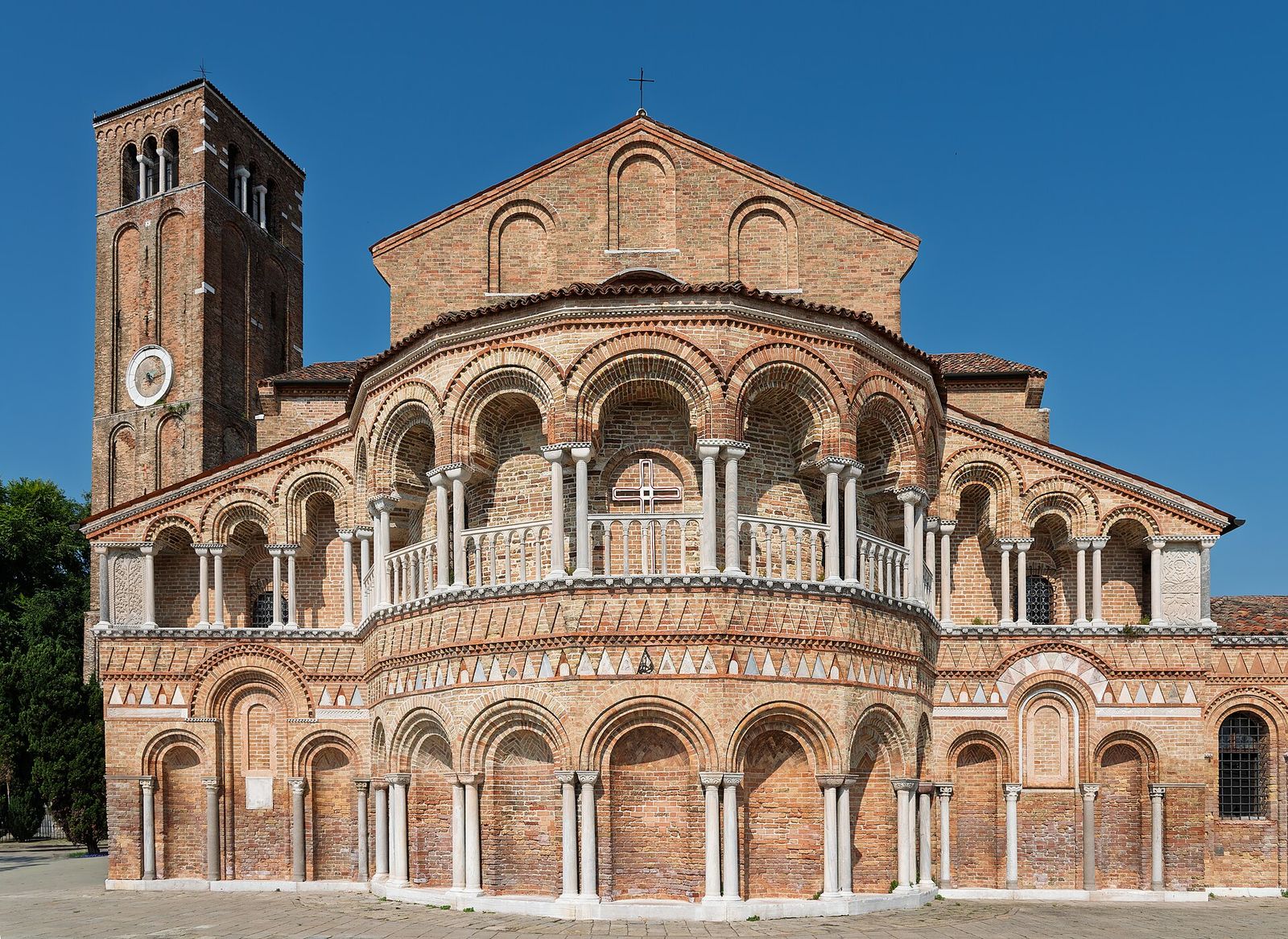
The building that matters most on Murano is the basilica of Santi Maria e Donato, a Veneto-Byzantine church of the twelfth century. Its finest side faces the canal rather than the square: the apse rises in two tiers of brick arcades with paired columns and patterned friezes, designed to be admired by people arriving from the water.
Inside, look down. The mosaic floor, laid in porphyry, serpentine, marble and other coloured stone, carries an inscription dating it to September 1141. Geometric patterns alternate with birds and other animals across the whole nave. Above the altar, a mosaic Virgin in deep blue stands alone on a gold ground, closely related to the one in the apse of the cathedral on Torcello; if both islands are on your plan, compare them on the same day.
The church is also dedicated to Saint Donatus, whose body was brought from the Greek island of Cephalonia in 1125. With it, legend says, came the bones of the dragon the saint had killed. Several large bones still hang behind the high altar. They are probably the remains of a whale, which makes them no less striking.
The Glass Museum
The Museo del Vetro occupies Palazzo Giustinian, once the residence of the bishops of Torcello, on the canal a few steps from the basilica. It began in 1861 as an archive of the island’s history, set up by the mayor of Murano, Antonio Colleoni, and the abbot Vincenzo Zanetti. It has been one of the city’s civic museums since 1923.
The collection follows the whole story, from Roman-era glass recovered in excavations to Renaissance goblets, enamelled pieces, mirrors, chandeliers and twentieth-century design. It is the best place to train your eye before you walk past the shop windows.
San Pietro Martire and the lighthouse
Among the glass shops of the Rio dei Vetrai stands San Pietro Martire. Founded in 1348 together with a Dominican convent, it burned down in 1474 and was rebuilt in its present form in 1511. It holds two paintings by Giovanni Bellini: the Barbarigo Altarpiece of 1488, in which Doge Agostino Barbarigo kneels before the Virgin and Child, and a later Assumption with saints. A Saint Jerome in the Desert by Paolo Veronese is also here.
Near the water-bus stop called Faro stands the stone lighthouse that gives the stop its name. The present tower dates from the 1930s and replaced an earlier metal structure put up in 1912. Although it stands well inside the lagoon, its light marks the approach to the Lido inlet, one of the three openings through which ships and the tide enter the lagoon.
Watching glass being made
Seeing a master shape a vase from a glowing gather of glass is the reason many people come to Murano, and some workshops open their furnaces to visitors at certain times. A little etiquette makes the visit better for everyone.
- Remember it is a workplaceFurnaces run at well over a thousand degrees. Stay behind any barrier, keep children close and never touch a newly made piece: glass stays dangerously hot long after it stops glowing.
- Ask before filmingSome masters are happy to be filmed, others are not. Flash and sudden movement distract people who are handling molten glass.
- Watch the teamworkA master rarely works alone. Assistants gather glass, reheat pieces in the furnace and hand over tools in a rhythm built up over years.
- Be wary of street offersOffers in the city of a quick boat to “a glass factory” usually end in a showroom. Make your own way to Murano and choose where to stop.
Telling handmade glass
Not everything sold as Murano glass was made on Murano, or made by hand at all. There is no single test, but a few general signs help.
- Look underneath. A hand-blown piece is usually finished on a rod, the pontil, which leaves a mark on the base; sometimes it is ground smooth.
- Expect small irregularities: slight differences in thickness, a tiny bubble, a shape that is not quite identical to its neighbour. Rows of perfectly identical pieces suggest a mould or a machine.
- Look at the joins. Handles, feet and decorations applied by hand flow into the body of the piece; glued parts and sharp seams do not.
- Ask questions. Whoever made or sells a piece should be able to tell you where and how it was made, and put that in writing.
An hour in the Glass Museum is the best training for the eye.
How to get there
Murano is served by several water-bus lines and has several stops. Journey times below are typical and depend on the line and the time of day.
Route card
Fondamente NovetoMurano
Tip
Colonna, the first stop, is closest to the Rio dei Vetrai; Museo is closest to the basilica and the Glass Museum.
Route card
Piazzale Roma or FerroviatoMurano
Tip
Handy if you arrive by train or bus: you can reach Murano without crossing the city first.
Route card
Murano FarotoBurano
Tip
Continue to Burano and Torcello for a full day in the northern lagoon.
Lines, routes and timetables change with the seasons. Check the public transport operator’s official information before you travel; the getting-around chapter explains how stops and lines work.
Questions
Can you walk from the city to Murano?
No. Murano is separated from the city by open water, with the cemetery island of San Michele in between. The crossing is made by boat.
How long should I allow?
Half a day is enough for the Rio dei Vetrai, the basilica and the Glass Museum. A full day lets you combine Murano with Burano and Torcello; see the day plan on the islands page.
Is Murano worth a visit if I am not interested in glass shopping?
Yes. The mosaic floor of Santi Maria e Donato, the Bellini paintings in San Pietro Martire, the museum and the quiet residential canals make a satisfying half day on their own.