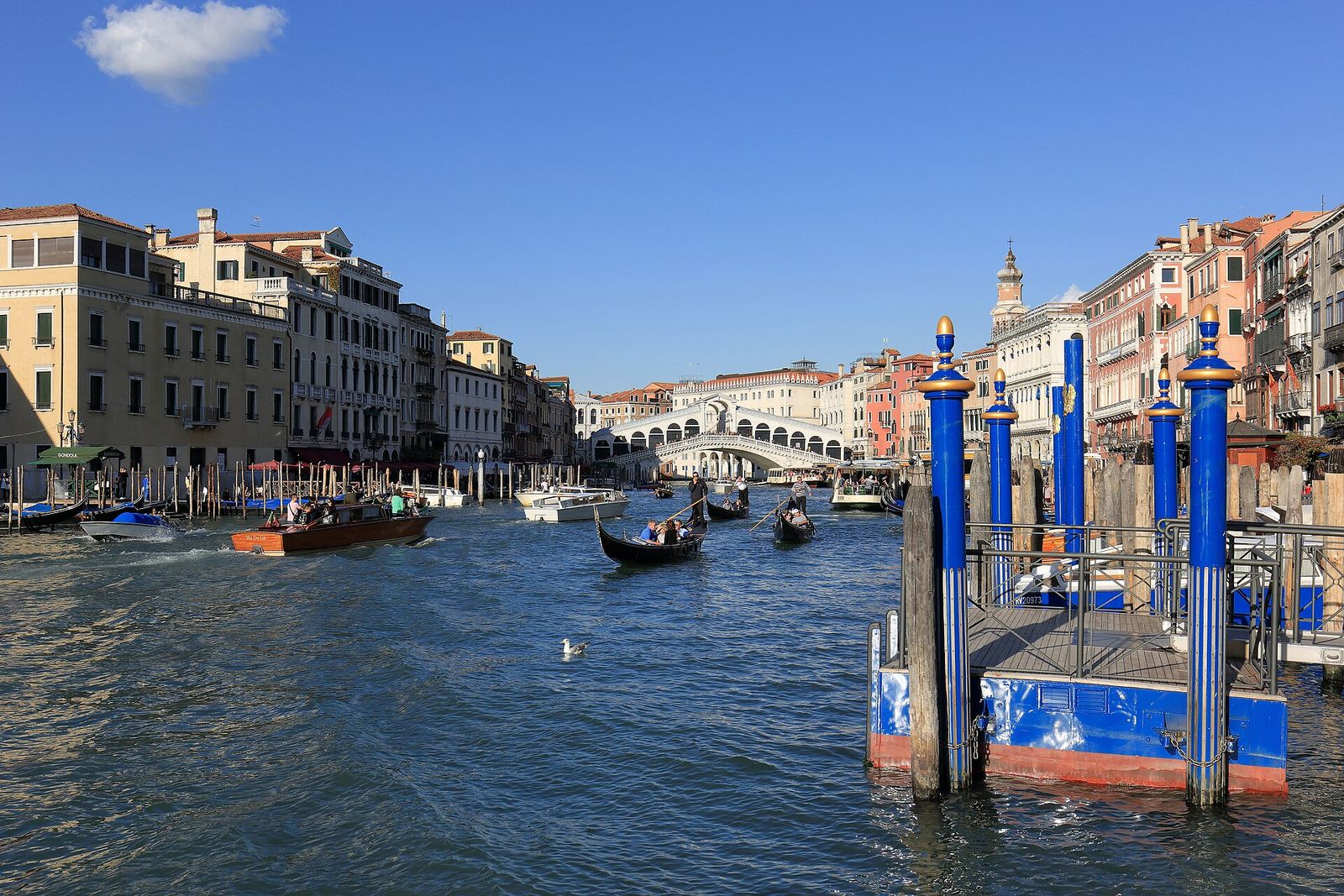
The Grand Canal carries almost everything Venice needs: water buses, delivery barges, ambulances, rubbish boats, gondolas and the private launches of people who live along it. It is also the best single introduction to the city’s architecture, because nearly every century from the 13th to the 18th has left a façade on its banks.
A reverse S through the city
On a map the Grand Canal looks like a backwards letter S laid across Venice. It probably follows the course of an old river channel, perhaps a branch of the Brenta, that wound through the lagoon before anyone built here. Today it runs for about 3.8 km, from the railway station and Piazzale Roma in the north-west to the Bacino di San Marco, the open basin in front of the Doge’s Palace.
Its width varies from roughly 30 to 90 metres and its average depth is about 5 m, enough for water buses and loaded barges to pass each other all day. Venetians call it Canałaso, the big canal; maps and signs give the Italian Canal Grande.
The canal also splits the city in two. Travelling down from the station, you have Cannaregio and then San Marco on your left. On your right come Santa Croce, San Polo and finally Dorsoduro, three of the six sestieri grouped on one bank. The Rialto sits near the middle of the S, and the sharp turn just beyond it, where Ca’ Foscari stands, is known locally as the volta de canal, the bend of the canal.
Four bridges
For centuries there was only one way to cross on foot. A pontoon bridge was laid at Rialto in the late 12th century and later replaced by wooden bridges, one of which collapsed under a crowd watching a wedding procession in 1444. The stone bridge you see today was designed by Antonio da Ponte and built between 1588 and 1591, after proposals by architects including Sansovino and Palladio had been set aside. Its single arch spans close to 30 m and carries two rows of shops under a central portico.
The other three crossings are modern. The first bridge at the Accademia, a metal structure of 1854, was replaced in 1933 by a wooden arch designed by the engineer Eugenio Miozzi as a temporary solution. It proved popular enough to keep, and in the mid-1980s it was rebuilt in the same shape with a steel frame beneath the timber. Miozzi also designed the Ponte degli Scalzi, a stone arch of 1934 in front of the station that replaced an Austrian iron bridge of 1858.
The fourth, the Ponte della Costituzione by Santiago Calatrava, opened in 2008 between Piazzale Roma and the station. Its shallow steel arch is elegant, but it has many steps and its glass treads proved slippery after rain; in 2022 the city decided to replace them with stone. The bridges chapter tells the story of each crossing in more detail.
- Rialto
- stone, 1591
- Accademia
- timber, 1933
- Scalzi
- stone, 1934
- Costituzione
- steel, 2008
Reading the façades
Palaces on the Grand Canal turn their best face to the water, because that is where visitors and goods arrived. A typical house has a water gate at canal level leading into a long ground-floor hall for unloading, and above it the main floor, the piano nobile, marked out by the widest windows and balconies. Read in order, the façades give a quick lesson in Venetian building, from Byzantine arcades to Baroque marble.
Byzantine and Gothic
The Fondaco dei Turchi, on the Santa Croce bank near the top of the canal, keeps a long arcaded front in the Veneto-Byzantine manner of the 13th century, although most of what stands behind it was rebuilt in the 1860s and 1870s. From the early 17th century until 1838 it housed the city’s Ottoman merchants; today it is the Natural History Museum.
Further down on the opposite bank, the Ca’ d’Oro was built between 1421 and 1437 for Marino Contarini. Its lacy Gothic tracery was once picked out in gold and colour, hence the name, the golden house. It now holds the Galleria Giorgio Franchetti, a state art collection. After the Rialto, at the bend, Ca’ Foscari is a late Gothic palace of the 1450s built for Doge Francesco Foscari and is now the main seat of the city’s university.
Baroque and after
Baldassare Longhena, the leading architect of 17th-century Venice, appears more than once. He began Ca’ Pesaro in 1659, a Baroque marble palace with a deeply carved façade, finished by Antonio Gaspari in 1710 and now home to museums of modern and oriental art. He also began Ca’ Rezzonico in 1649; Giorgio Massari completed it in the 1750s, and it is now the museum of 18th-century Venice. Massari also designed Palazzo Grassi, almost opposite, built between 1748 and 1772 and remembered as the last palace raised on the canal before the Republic fell in 1797. It is used for exhibitions of contemporary art.
At the mouth
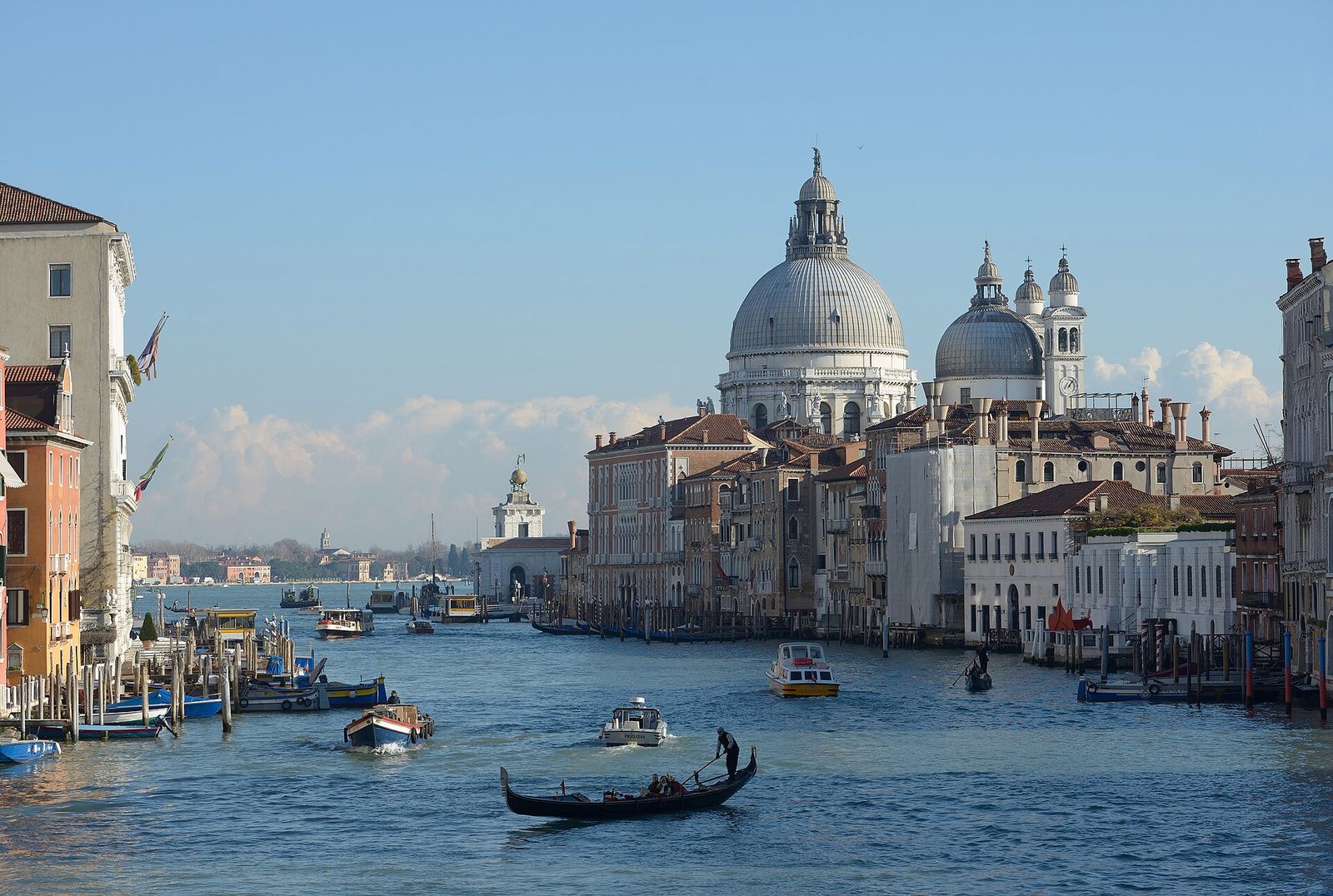
The canal ends with two buildings that frame the view from the water. Santa Maria della Salute was vowed after the plague of 1630, begun to Longhena’s design in 1631 and completed in the 1680s; it is said to stand on about a million wooden piles. Beyond it, at the tip of Dorsoduro, the Punta della Dogana is the old sea customs house of 1678–1682 by Giuseppe Benoni, topped by a golden globe carried by two Atlases and a figure of Fortune that turns with the wind. Since 2009 it has been a museum of contemporary art.
Riding the whole canal
Very little of the Grand Canal can be walked along: most palaces stand straight in the water, and the only long stretches of quay are near the station and around the Rialto, where the Riva del Vin and the Riva del Carbon face each other below the bridge. To see the whole canal you need a boat.
The simplest choice is the slow water bus that calls at almost every landing stage. At the time of writing this is line 1, which runs from Piazzale Roma down the full length of the canal to San Marco and continues to the Lido; faster lines skip stops or go round the outside of the city. Line numbers and routes do change, so read the sign on the landing stage before boarding; the getting around chapter explains how stops and platforms work. The trip from Piazzale Roma to San Marco takes roughly three-quarters of an hour.
Crossing by traghetto
Between the bridges, gondola ferries called traghetti cross the canal at a few fixed points. A traghetto is a plain working gondola rowed by two gondoliers, one at each end, and the crossing lasts only a couple of minutes. Venetians traditionally make it standing up; visitors are welcome to sit.
There used to be many more of these ferries than there are today. At the time of writing a handful still run, among them Santa Sofia, between the Ca’ d’Oro side and the Rialto fish market, and San Tomà, a short walk from the Frari. Service hours vary with the season and some crossings run only part of the day.
Regata Storica and festival days
On the first Sunday in September the canal becomes a racecourse. The Regata Storica opens with a parade of historic boats rowed by crews in period costume, followed by races in traditional Venetian boats rowed standing, Venetian style. The finish is at the volta de canal by Ca’ Foscari. Ordinary traffic is halted for several hours and water-bus routes change, so check official notices if you are travelling that day.
The Grand Canal is less a monument than a working street that happens to be lined with palaces.
On 21 November, for the Festa della Salute, a temporary bridge on pontoons crosses the canal from Campo Santa Maria del Giglio so that people can walk to Longhena’s church to give thanks for the end of the plague. It is the only time of year when you can cross the canal on foot at that point.
Where to watch from
The classic views are from the bridges. The Rialto looks both up and down the busiest stretch; the Accademia gives the famous view towards the Salute; the Scalzi shows the canal opening out beyond the station. From the tip of the Punta della Dogana you can watch the Grand Canal and the Giudecca Canal meet the basin, with San Giorgio Maggiore across the water (see Giudecca & San Giorgio).
Early morning is the best time to see the canal at work, when barges deliver to the Rialto market. Late afternoon is kinder to the stone, and after dark the lit windows make a slow ride memorable. In the colder months the lowest quays around the Rialto are among the first places to flood at high tide; the tides chapter explains how to read the forecasts.
Canal manners
- Treat it as a streetStay back from the edge of landing stages unless you are boarding, and never step onto moored gondolas or private boats.
- Keep the bridges movingOn the Rialto and the Accademia, step to the side before you stop for a photograph.
- Make room on the water busTake your backpack off, let passengers get off first and keep luggage out of the gangway.
- Stay out of the waterSwimming in the canals is forbidden, and the traffic makes it dangerous.
Route cards
Three ways to meet the Grand Canal. Journey times are typical and depend on the time of day and the traffic.
Route card
Piazzale RomatoSan Marco
Tip
Board at the first stop, where you have the best chance of an outside seat.
Route card
Santa SofiatoRialto fish market
Tip
Come in the morning, when the market is open and the ferry is busiest.
Route card
Railway stationtoRialto Bridge
Tip
Follow the yellow “Per Rialto” signs painted on the walls; the route crosses the Cannaregio Canal at the Ponte delle Guglie.
Lines, timetables and traghetto hours change. Check the public transport operator’s official information before you travel.
Questions
Can you walk the length of the Grand Canal?
No. Most of its banks are lined with buildings standing in the water. You can follow short quays near the station and the Rialto, and cross at the four bridges or by traghetto, but to see the whole canal you need to be on a boat.
Which side of the water bus should I sit on?
There is no best side, since landmarks line both banks. If you can, ride the canal in both directions, or sit at the open front or back of the boat where you can look both ways.
Is the canal ever closed to traffic?
Yes, for a few hours on Regata Storica day and during some other events. Water-bus routes are diverted at those times; the City of Venice and the public transport operator publish notices in advance.